
Why there's no Graduate Route equivalent
The US has OPT. The UK has the Graduate Route. Australia has the 485 visa. All three let graduates stay and work for a fixed period without a job offer in hand first. Singapore has no equivalent. There is no automatic, employer-independent post-study permit. To remain in Singapore after a master's, a graduate needs a confirmed job offer from a Singapore-registered company, and that company needs to sponsor either an Employment Pass or an S Pass on their behalf, according to MOM.
This changes the entire post-study calculation. Students planning for the US, UK, or Australia can graduate first and job-hunt with a work permit already active. Students planning for Singapore need the job offer locked in before graduation changes their visa status at all.
Employment Pass requirements
The Employment Pass (EP) is Singapore's main work visa for professionals, managers, and executives. For applications submitted before 1 January 2027, the minimum qualifying salary starts at S$5,600/month for candidates aged 23 or under in most sectors, and S$6,200/month in financial services. This isn't flat — it scales up with age, reaching S$10,700/month (general) or S$11,800/month (financial services) for candidates 45 and above, according to MOM.
| Age band | General sectors | Financial services |
|---|---|---|
| 23 and under | S$5,600/month | S$6,200/month |
| 45 and above | S$10,700/month | S$11,800/month |
This is a fixed monthly salary requirement — bonuses, allowances, and variable pay don't count toward it. Most graduates entering their first role fall at or near the youngest age band, which is the relevant threshold to check against a starting salary.
The COMPASS framework
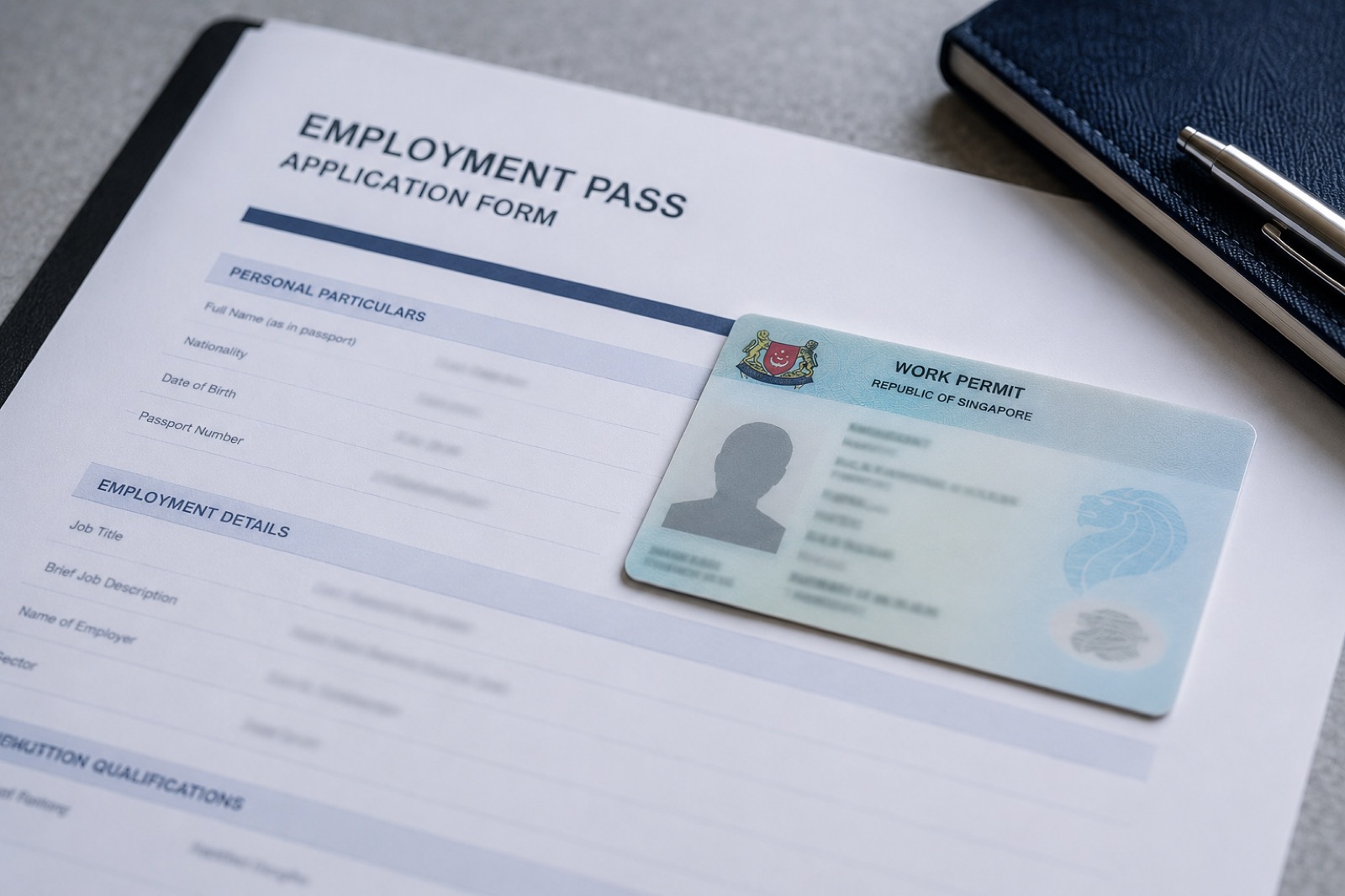
Clearing the salary bar isn't the whole test. Every EP application then has to pass COMPASS, a points-based framework, and candidates need at least 40 points to qualify. COMPASS scores across six criteria: salary, qualifications, workforce diversity, support for local employment, a skills bonus tied to a shortage occupation list, and a strategic economic priorities bonus, according to MOM.
Salary above the 65th percentile of local PMET pay in the same sector earns 10 salary points; above the 90th percentile earns the full 20. A salary that just clears the minimum floor won't automatically clear COMPASS.
Candidates earning above S$22,500/month are exempt from the COMPASS assessment entirely, but that threshold is well above what most new graduates are offered.
S Pass requirements
The S Pass sits a tier below the EP and is meant for mid-skilled roles. For applications before 1 January 2027, the minimum is S$3,300/month in most sectors and S$3,800/month in financial services, again scaling up with age — for example, a candidate around 35 needs roughly S$4,800/month to qualify, according to MOM. As with the EP, this must be fixed salary; commissions and bonuses don't count.
What changes in 2027
Both passes get more expensive to sponsor starting 1 January 2027. The S Pass minimum rises to S$3,600/month for general sectors and S$4,000/month for financial services for new applications, with renewals following from 1 January 2028, according to government confirmation. EP minimums for new applications also step up from that date. Students graduating into a 2027 job search should budget for a slightly higher offer to clear these updated floors.
Key takeaways
- No automatic post-study visa — a job offer and employer sponsorship come first, not after graduation.
- Employment Pass: from S$5,600/month (general) or S$6,200 (financial services), scaling with age, plus a 40-point COMPASS pass.
- S Pass: from S$3,300/month (general) or S$3,800 (financial services), also age-scaled.
- Both salary floors rise on 1 January 2027 — factor this into any offer negotiated late in the year.
Frequently asked questions
Does Singapore have a post-study work visa like OPT or the Graduate Route?
No. Singapore has no automatic post-study work permit. Graduates need a confirmed job offer and direct employer sponsorship for an Employment Pass or S Pass before they can stay and work, according to MOM.
What salary do I need for a Singapore Employment Pass?
For applications before 1 January 2027, the minimum qualifying salary starts at S$5,600/month for candidates 23 or under in most sectors (S$6,200 in financial services), rising progressively with age to S$10,700 (S$11,800 financial services) at 45 and above, according to MOM.
What is the COMPASS framework?
COMPASS is a points-based assessment all Employment Pass applications must pass after meeting the salary bar. Candidates need at least 40 points across six criteria: salary, qualifications, diversity, support for local employment, a skills bonus, and a strategic economic priorities bonus, according to MOM. Applicants earning above S$22,500/month are exempt.
What salary do I need for a Singapore S Pass?
For applications before 1 January 2027, the minimum is S$3,300/month in most sectors (S$3,800 in financial services), rising with age. From 1 January 2027, these rise to S$3,600 and S$4,000 respectively, according to MOM.
Planning your Singapore job search timeline?
Book a free strategy call and we'll map how your program, industry, and target salary line up against these thresholds.
Book your free strategy call →Keep reading
Sources & further reading
- Employment Pass: Eligibility (official) — Ministry of Manpower, Singapore
- S Pass: Eligibility (official) — Ministry of Manpower, Singapore
- COMPASS framework (official) — Ministry of Manpower, Singapore