
Credential evaluation: WES
World Education Services (WES) is the credential evaluation body most commonly required by US and Canadian universities and immigration processes. It confirms that your degree from another country is equivalent to a recognized US or Canadian credential. There are two tiers: Document-by-Document, starting at $118, which confirms overall degree equivalency, and Course-by-Course, starting at $186, which goes further and converts every individual course and grade onto a 4.0 GPA scale, according to WES. Evaluation prices rose 3% effective 1 January 2026.
| Evaluation type | Starting price | What it covers |
|---|---|---|
| Document-by-Document | $118 | Confirms overall degree equivalency |
| Course-by-Course | $186 | Converts every course/grade to 4.0 GPA scale |
Check which tier your target program or visa process actually specifies before ordering. Course-by-Course is more expensive and takes longer to process, and many applications only require Document-by-Document.
Apostille vs. attestation
An apostille is a single-step certificate issued by a competent authority in your home country that verifies a document's authenticity for use in any of the 120+ countries that are members of the 1961 Hague Apostille Convention. Once apostilled, no further embassy or consular step is needed in another member country.
Attestation is the older, multi-step process required for documents headed to countries that are not members of the Convention. It typically involves verification at multiple levels, including notarization, a state or national authority, and the destination country's embassy or consulate, before the document is accepted.
Official transcripts
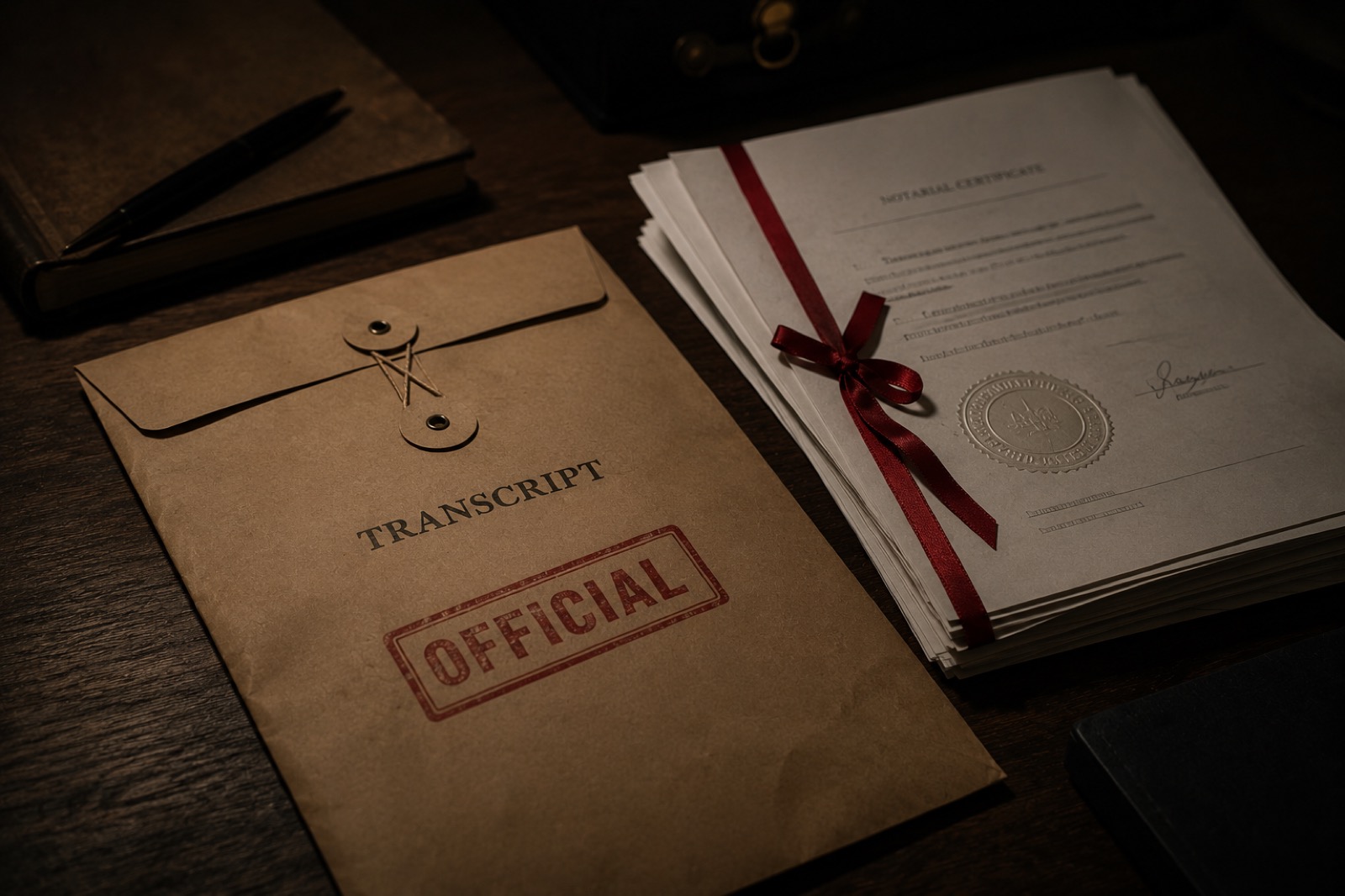
Separate from both of the above, most universities require official transcripts sent directly from your previous institution, either by post in a sealed envelope or through a secure digital transcript service. This step exists regardless of whether a credential evaluation or apostille is also required, and it's often the one applicants forget to request early enough, since it depends on another institution's own processing timeline, not your own.
Realistic timelines
WES describes standard processing as roughly 7-20 business days once all required documents have been received and accepted. But the realistic end-to-end timeline, factoring in gathering documents, sending them, and any resubmissions, typically runs 4-7 weeks, according to WES. Apostille and attestation processing times vary significantly by country and issuing authority, and should be started as early as transcripts, not after.
Key takeaways
- WES Document-by-Document: from $118. Course-by-Course: from $186 (3% increase from Jan 2026).
- Apostille covers 120+ Hague Convention member countries in one step; non-member countries need attestation.
- Official transcripts are a separate requirement from evaluation or apostille — request them early.
- Budget 4-7 weeks realistic end-to-end, not the 7-day headline processing figure alone.
Frequently asked questions
How much does a WES credential evaluation cost?
Document-by-Document evaluations start at $118 USD, and Course-by-Course evaluations start at $186 USD, according to WES. Evaluation prices rose 3% effective January 1, 2026.
What's the difference between WES Document-by-Document and Course-by-Course evaluation?
Document-by-Document confirms your credential is equivalent to a US or Canadian degree, at a lower cost. Course-by-Course goes further, converting every individual course and grade onto a 4.0 GPA scale, which many universities and some visa or immigration processes specifically require.
What's the difference between an apostille and attestation?
An apostille is a single-step certificate that verifies a document for use in any of the 120+ Hague Apostille Convention member countries. Attestation is a multi-step embassy or consular legalization process required for documents used in non-member countries.
How long does document authentication take?
WES evaluations typically take about 7-20 business days once all required documents are received, but the realistic end-to-end timeline, including document submission and transit, usually runs 4-7 weeks, according to WES.
Getting your documents ready for applications?
Book a free strategy call and we'll map exactly which of these your target programs require.
Book your free strategy call →Keep reading
Sources & further reading
- Credential Evaluations and Fees (official) — World Education Services (WES)
- Current Processing Times (official) — World Education Services (WES)
- Explanatory Report on the 1961 HCCH Apostille Convention (official) — Hague Conference on Private International Law (HCCH)