The application process
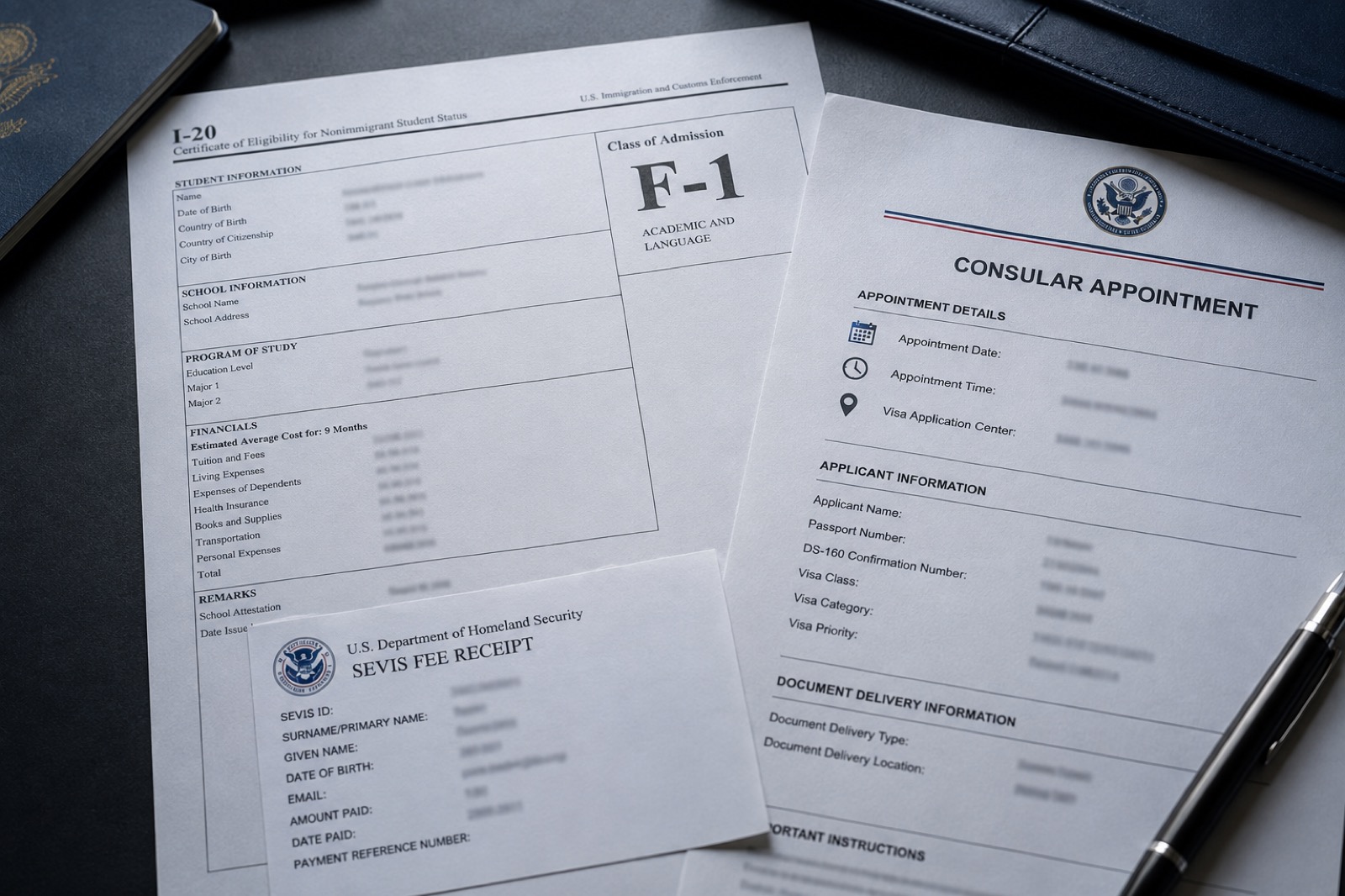
The F-1 process has four real checkpoints, in order. First, your school issues an I-20 once you accept your offer. Second, you pay the $350 SEVIS fee, which funds the tracking system that monitors international students. Third, you complete the DS-160 online application, roughly $185. Fourth, you attend a consular interview with your passport, DS-160 confirmation page, a photo, your original I-20, and the SEVIS fee receipt.
Every detail on your I-20, your name, date of birth, and programme dates, must match your DS-160 and your interview answers exactly. Mismatches are a common, entirely avoidable cause of delay.
Section 214(b): the real risk
Section 214(b) of the Immigration and Nationality Act presumes that every non-immigrant visa applicant intends to immigrate permanently, until the applicant proves otherwise. For F-1 applicants, this means the burden of proof sits entirely with you to demonstrate genuine non-immigrant intent and financial ability, not with the consular officer to prove you don't qualify. This is the single most common reason F-1 visas get refused. Roughly 35% of F-1 visas were refused in 2025, up from 31% in 2024 and 23% in 2015, according to reported State Department figures, with refusal rates varying significantly by applicant's country.
When to apply and enter
You can apply for and receive your F-1 visa up to 365 days before your programme's start date on the I-20, a change from the previous, much shorter window. However, holding a valid visa doesn't mean early entry: you still cannot enter the United States more than 30 days before that start date, regardless of when your visa was issued.
Key takeaways
- Core costs: $350 SEVIS fee + ~$185 DS-160 application fee.
- Every I-20 detail must match your DS-160 and interview answers exactly.
- Section 214(b) puts the burden of proof on you to show non-immigrant intent.
- ~35% of F-1 visas were refused in 2025, trending upward from 23% in 2015.
- Apply up to 365 days early; enter no more than 30 days before your start date.
Frequently asked questions
What documents do I need for the F-1 visa interview?
Your passport, the DS-160 confirmation page, a photo, the original I-20 issued by your school, and the SEVIS fee receipt. Every detail on the I-20, including your name, date of birth, and program dates, must match your DS-160 and interview answers exactly.
What is Section 214(b) and why does it matter for F-1 visas?
Section 214(b) of the Immigration and Nationality Act presumes every non-immigrant visa applicant intends to immigrate permanently, unless the applicant proves otherwise. F-1 visas are refused under this section more than any other reason, and the burden of proof sits entirely with the applicant.
What is the F-1 visa refusal rate?
Roughly 35% of F-1 visas were refused in 2025, up from 31% in 2024 and 23% in 2015, according to reported State Department data. Refusal rates vary significantly by country.
How far in advance can I apply for an F-1 visa?
You can apply for and receive your F-1 visa up to 365 days before your program start date. However, you cannot enter the United States more than 30 days before that start date, even with a valid visa already issued.
Preparing for your F-1 visa interview?
Book a free strategy call and we'll pressure-test your documents and intent narrative together.
Book your free strategy call →Keep reading
Sources & further reading
- F-1 visa process — Study in the States, US Department of Homeland Security (official)
- Visa issuance timeline change (365-day rule) — US Department of State policy update, February 2023